 Skip to main content


From nutritious meals to school prep to doctor checkups, parents are already doing so much to help your child thrive. But in that day-to-day shuffle and planning, there are often aspects of care that can be overlooked, one of which is their vision.
Your child’s eyes are quietly working overtime every single day, soaking in colors, shapes, words on a whiteboard, and faces across the room. When something’s off, kids often don’t even realize it. To them, the blurry world they see is just… the world.
That’s why regular eye exams for kids are so crucial to maintain their overall health. They’re one of the most important investments you can make in your child’s health, learning, and confidence. Let’s walk through everything you need to know.
Why Kids Need Regular Eye Exams
Children’s eyes are still developing, and that development happens fast. From the moment a baby first focuses on a parent’s face to the day a kindergartner reads their first sentence, vision is at the center of it all. Regular eye exams give your child’s eye doctor the chance to catch problems early, when they’re easiest to treat. Here’s why consistent eye care matters so much for growing kids:
Detecting Vision Problems Early
Some of the most common childhood eye conditions — like lazy eye (amblyopia), crossed eyes (strabismus), and refractive errors such as nearsightedness or farsightedness — don’t always come with obvious warning signs. A child may not squint dramatically or complain about blurry vision. They simply adapt. Regular exams catch these issues before they become harder to treat, and in many cases, early intervention makes all the difference.
Supporting Academic Performance
Something many parents don’t realize: vision problems are one of the leading contributors to reading difficulties and classroom struggles. When your child skips lines while reading, loses their place, or avoids close-up work, it might be their eyes. Treating vision problems early can unlock better reading fluency, improved concentration, and a more positive school experience.
Preventing Long-Term Eye Issues
Just like treating a small cavity is far simpler than a root canal, catching eye problems early means less invasive treatment later. Conditions like amblyopia respond much better to treatment in young children than in teenagers or adults. Regular monitoring keeps your child’s vision on the right track and, in tandem, keeps bigger interventions off the table.
When Should a Child Have Their First Eye Exam?
Many parents assume eye exams begin around kindergarten. However, the American Optometric Association recommends a child’s first comprehensive eye exam as early as age 1. Your child’s vision journey begins in infancy, and the earlier any issues are spotted, the better the outcomes. Here’s a simple breakdown by age:
Infants and Toddlers (Birth – Age 2)
Eye doctors recommend that babies have their first comprehensive eye exam by age 1 or sooner if you notice anything unusual, like eyes that seem misaligned, one eye that drifts, or sensitivity to light. Infant eyes develop rapidly, and some conditions are best identified and treated in this early window.
Preschool Age (3–5 Years)
This is a milestone age for vision checks. A full eye exam during the preschool years helps confirm that your child’s visual development is on track, checks for differences between the two eyes, and screens for conditions that could affect learning readiness. Think of it as setting the stage for a bright (and clearly seen!) kindergarten debut.
School-Age Children (Ages 6 and Up)
Once children are in school, annual or biannual eye exams are recommended. Vision changes frequently during the school years, and new refractive errors like myopia (nearsightedness) can develop seemingly overnight. Keeping up with regular exams means your child always has the clearest possible view of that classroom whiteboard.
Quick Tip: Even if your child recently passed a school vision screening, that’s not the same as a comprehensive eye exam. School screenings only check for basic acuity. They miss a wide range of conditions.
What Happens During a Kid’s Eye Exam?
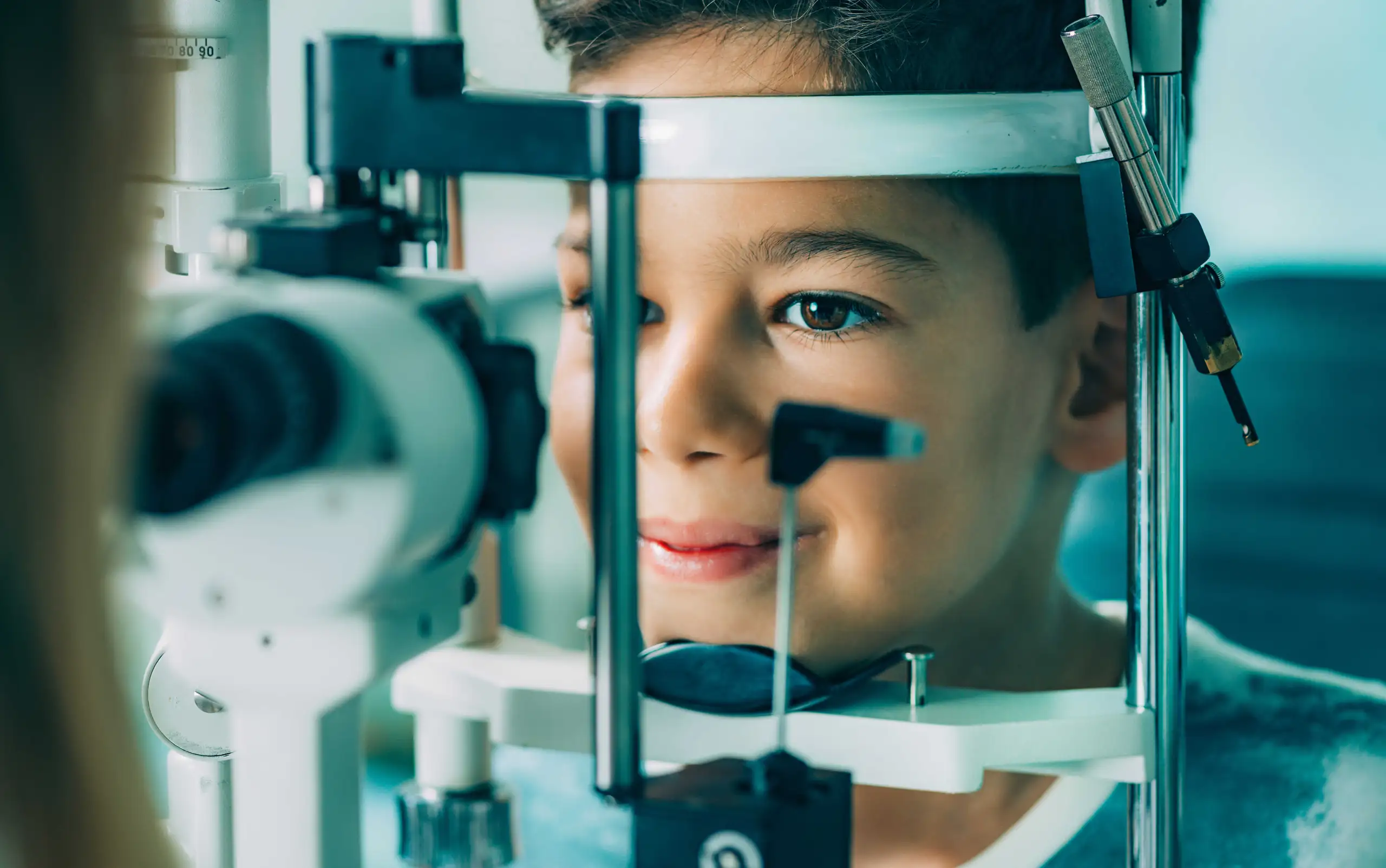
If your little one has never had an eye exam before, you might be wondering what to expect. The good news? These eye exams are designed with kids in mind — no scary tools, no complicated instructions, and plenty of patience from your child’s eye care team.
Vision Screening vs. Comprehensive Eye Exam
- A vision screening (like the one at school or the pediatrician’s office) is a quick check, usually just reading letters on an eye chart from a distance. It can flag obvious issues, but misses many common conditions.
- A comprehensive eye exam goes much deeper. It evaluates how well both eyes work together, how your child focuses at different distances, the health of the internal structures of the eye, and more. It’s the full picture.
For the most complete assessment of your child’s vision health, a comprehensive exam is always the better choice.
What the Doctor Checks
- Visual acuity — how clearly they can see at near and far distances (yes, often using that classic eye chart!)
- Eye alignment and coordination — making sure both eyes are working as a team
- Focusing ability — how well the eyes shift focus between near and far objects
- Eye movement — tracking and following moving objects smoothly
- Internal eye health — examining the retina, optic nerve, and other structures
Child-Friendly Tools and Tests
Worried your toddler can’t read the alphabet yet? No problem! Pediatric eye doctors are experts at testing young children using age-appropriate methods:
- Picture charts and matching games for young children who don’t yet know their letters
- Retinoscopes and special lenses to measure prescriptions without the child needing to say a word
- Pupil dilation drops (when needed) to get a clear view of the back of the eye — these may temporarily cause light sensitivity and blurry close vision, so plan accordingly
The whole appointment is typically warm, gentle, and designed to feel more like an adventure than a medical procedure, especially at a pediatric-focused practice.
Signs Your Child Might Need an Eye Exam Sooner
- Squinting frequently, tilting their head to one side, or covering one eye
- Sitting unusually close to the TV or holding books very near their face
- Complaints of headaches, eye strain, or tired eyes — especially after reading or screen time
- Rubbing their eyes often, even when they’re not tired
- A family history of glasses, lazy eye, or other eye conditions
If any of these sound familiar, trust that instinct. Don’t wait for the next scheduled appointment. Our blog on Signs Your Child May Need Glasses breaks down each of these signals in detail and can help you decide when it’s time to make that call sooner.
What Eye Conditions Can Be Detected?
Children’s eyes face a surprisingly wide range of potential challenges. The encouraging news is that most common childhood eye conditions are very treatable, especially when caught early. A comprehensive eye exam can detect:
- Lazy eye (amblyopia): When one eye doesn’t develop vision as strongly as the other, the brain begins to favor the stronger eye. Without treatment, the weaker eye can lose function over time.
- Crossed eyes (strabismus): Eyes that point in different directions can affect depth perception and sometimes lead to amblyopia if untreated.
- Nearsightedness (myopia), farsightedness (hyperopia), and astigmatism: These refractive errors are extremely common and very manageable with the right corrective lenses.
- Color blindness: Identifying color vision deficiencies early helps parents and teachers provide appropriate support in learning environments.
- Eye coordination problems: Issues with how the two eyes work together can cause eye strain, headaches, and reading difficulties that are often mistaken for learning disabilities.
Curious about what treatment looks like for each of these? Our guide to common childhood eye problems walks through every condition in more depth, including what to expect from diagnosis through care.
How Often Should Kids Get Eye Exams?
Here’s the simple answer: more often than you might think, and the schedule shifts as your child grows.
General Guidelines by Age
- By age 1: First comprehensive exam
- Ages 3–5: At least one full exam before starting school
- Ages 6 and up: Annually, or every two years if vision is stable and no risk factors are present
Some children benefit from more frequent monitoring, including those with:
- A family history of eye conditions, glasses, or lazy eye
- Existing refractive errors or prescribed eyeglasses
- A history of premature birth, which can affect visual development
- Developmental delays, learning differences, or conditions like Down syndrome
When in doubt, follow the guidance of your child’s eye doctor — they’ll set a monitoring schedule that fits your child’s specific needs.
Bright Eyes Start Here
Your child sees the world through their eyes every single moment of every single day. When their vision is clear, they can read confidently, explore freely, connect with the faces they love, and show up to the classroom ready to learn. When something’s off, even just a little, it ripples into every part of their life.
At our locations, we make children’s eye exams welcoming, thorough, and tailored to your child’s age and needs. From your baby’s first exam to your teenager’s annual checkup, we’re here every step of the way.
Ready to schedule your child’s next eye exam? Find a location near you and check your insurance coverage today. Clear vision and a brighter future could be just one appointment away.