 Skip to main content


Childhood myopia, more commonly known as nearsightedness, is showing up in more kids than ever, and the numbers keep climbing.
A lot of parents hear “myopia” and assume glasses will take care of it. Glasses do help kids see clearly, but myopia that isn’t managed can keep changing throughout childhood and the teen years.
This guide covers what myopia is, what causes it, how to spot it in your child, and the treatment options available today, from correcting a child’s vision to slowing how quickly it progresses.
What Is Myopia (Nearsightedness)?
Myopia is a refractive error. In a myopic eye, close objects look clear, but anything at a distance looks blurry. This happens because the eyeball has grown too long from front to back, or the cornea is curved more than it should be. Either way, light entering the eye focuses in front of the retina instead of landing directly on it, and that mismatch is what blurs distance vision.
Myopia is one of a few common refractive errors:
- Hyperopia (farsightedness): the opposite problem. Close-up vision is harder, while distance vision often stays clear.
- Astigmatism: an irregularly shaped cornea that blurs vision at all distances, near and far.
Myopia typically shows up during the school-age years and tends to increase through adolescence as a child’s eyes keep growing, usually leveling off in the early to mid-20s.
Is It Normal for Kids to Be Nearsighted?
Yes. Myopia is one of the most common vision conditions in children, and its prevalence is rising worldwide.
Myopia that goes undetected and unmanaged tends to progress, and higher levels of myopia carry a greater risk of serious eye conditions later in life. Catching it early and managing it well makes a real difference for a child’s long-term eye health.
What Causes Nearsightedness in Children?
Myopia doesn’t come from a single cause. It’s usually a combination of genetics and everyday habits and environments.
Does Nearsightedness Run in Families?
A child with one nearsighted parent has a meaningfully higher risk of developing myopia. A child with two nearsighted parents has an even higher risk.
Family history is useful information for parents to have. If myopia runs in the family, earlier and more frequent eye exams are worth scheduling, so any changes get caught quickly.
Nearsightedness and Screen Time
Screens get a lot of the blame for kids’ eyesight, but research hasn’t established that screens alone cause myopia.
What does seem to matter is the pattern behind the screen time: extended reading, writing, and device use, paired with too little time outdoors, are linked to higher rates of myopia and faster progression.
Time Outdoors as a Protective Factor
Kids who spend more time outside tend to develop myopia less often. Researchers believe natural light exposure and the visual habit of focusing on things far away both play a role.
For parents, this is one of the few risk factors you can act on. Getting kids outside regularly, even in short daily stretches, is a simple, low-cost way to support their eyes.
How the Eye Grows
Myopia develops as the eyeball gradually gets longer during childhood growth. That’s why it often worsens year after year through adolescence, and why slowing that growth, known as myopia control, is a goal in children’s eye care.
Symptoms of Myopia in Children
Kids usually don’t complain about blurry vision. They don’t have a clear memory of what sharp distance vision looks like, so blurry just feels normal to them. That means parents and teachers are often the first to notice something’s off.
Here’s what to watch for:
Blurry Vision at a Distance
Blurry vision is the main symptom to watch for:
- Trouble seeing the board at school
- Reading street signs
- Recognizing someone across a room
Kids may not mention this on their own, so watch for academic slipping or a child avoiding activities that require good distance vision.
Squinting
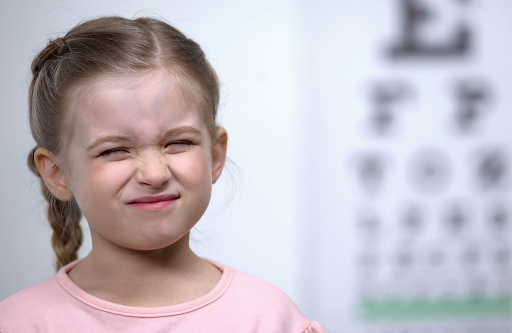
Squinting temporarily sharpens focus on distant objects. A child who squints often, especially while watching TV or looking at the board, is a reliable early signal.
Sitting Too Close to Screens or the TV
A child who keeps inching toward the screen, or holds a tablet close to their face, may be doing that to compensate for blurry distance vision.
Headaches and Eye Strain
Straining to focus on things far away is tiring on the eyes, and that fatigue can show up as headaches or general eye strain, particularly after school or activities that require sustained distance vision.
Rubbing Eyes Frequently
Frequent eye rubbing can be another sign of the same underlying eye strain.
How Serious Is Myopia in Kids?
Mild myopia is usually easy to manage with glasses or contacts, but myopia that progresses significantly through childhood carries real long-term risks.
Higher levels of myopia, what eye doctors call high myopia, are associated with an increased lifetime risk of serious eye conditions, including retinal detachment, glaucoma, cataracts, and myopic maculopathy.
Is Myopia Curable? Can Nearsightedness Be Reversed?
No, myopia cannot currently be cured or reversed in children. The elongation of the eyeball that causes it is a structural change, and it’s permanent.
Myopia can be corrected so a child sees clearly, and its progression can be slowed with the right interventions.
Refractive surgery, such as LASIK, becomes an option once a person’s prescription has stabilized, usually in adulthood. It isn’t appropriate for children, since their eyes are still developing.
How to Fix Nearsightedness in Children: Correction vs. Control
There are two separate goals when it comes to treating myopia, and it helps to understand the difference between them.
- Correction means helping a child see clearly today
- Control means slowing how quickly their myopia gets worse over time
Corrective Eyeglasses
Glasses are usually the first step. Prescription lenses correct the refractive error and restore clear distance vision. Since kids’ eyes keep changing as they grow, prescriptions typically need updating every year or so.
Glasses correct vision, but on their own, they don’t slow how fast myopia progresses.
Standard Contact Lenses
Standard contacts are an option for older kids and responsible teens ready for the extra care contacts require. Like glasses, they correct vision but don’t address progression on their own. Age and maturity are worth considering since contacts require proper handling and hygiene.
How to Stop Myopia Progression in Kids
Myopia control is a growing area of children’s eye care, focused specifically on slowing how fast myopia progresses, not just correcting it.
Several options are backed by clinical research, and your child’s eye care provider can help decide which one fits best based on age, prescription, and lifestyle.
Low-Dose Atropine Eye Drops
Applied nightly, low-dose atropine drops have been shown in clinical studies to significantly slow myopia progression in children. This is an off-label use, though it’s widely studied and increasingly common.
Atropine drops don’t correct vision on their own, so they’re typically used alongside glasses or contacts.
MiSight Contact Lenses
MiSight is the first contact lens the FDA has approved specifically for myopia control in children. It’s a daily disposable soft lens with a dual-focus design, so it corrects vision and helps slow eye elongation at the same time.
It’s approved for children 8 to 12 years old when they start treatment, and many kids that age can learn to put the lenses in and take them out on their own, with a parent nearby to help.
It’s a daily disposable, there’s no cleaning or storing lenses overnight, which makes it a manageable option for a first-time contact lens wearer.
Orthokeratology (Ortho-K)
Ortho-K lenses are rigid, gas-permeable lenses worn overnight. They gently reshape the cornea while a child sleeps, so vision is clear during the day without glasses or contacts.
Evidence suggests Ortho-K also helps slow myopia progression. Fit matters with this option, so it requires careful fitting and regular follow-up visits.
Multifocal Contact Lenses
Multifocal lenses were originally designed for adults with presbyopia, the age-related loss of close-up focus that tends to show up in a person’s 40s, but they’ve also shown myopia control benefits in children.
They work by presenting different focal zones in the lens, which reduces the visual signal believed to drive eye elongation.
Essilor Stellest Glasses
Stellest is a newer glasses-based option built specifically for myopia control in kids. It’s a good fit for younger children, or for those who aren’t ready for contact yet, giving families a glasses-based path to slowing progression.
Lifestyle Factors: What Parents Can Do at Home
Clinical treatment matters most, but everyday habits support it. A few things parents can do at home:
- Aim for 1 to 2 hours of outdoor time each day
- Use the 20-20-20 rule during close-up work: every 20 minutes, look at something 20 feet away for 20 seconds
- Make sure reading and close work happen in good light
- Keep an eye on screen distance and posture
- Schedule eye exams annually, or more often if myopia is progressing
When to Schedule an Eye Exam
Catching myopia early gives your child’s eye care team more options and more time to manage how it progresses.
Our eye care providers see kids like yours every day, and we’re glad to answer questions and set your child up with a clear, comfortable exam. Schedule an eye exam at one of our locations near you.