 Skip to main content


So much of childhood happens through the eyes. Reading a favorite bedtime story, spotting a friend across the playground, copying spelling words from the board. Vision is foundational to how kids learn, socialize and make sense of the world around them.
That’s why astigmatism deserves a spot on every parent’s radar. It’s one of the most common childhood vision problems, yet it often goes undetected for a simple reason: kids don’t know what “normal” vision looks like. If the world has always been a little blurry, a child has no way of knowing it could be clearer. They can’t tell you what they’ve never seen.
Fortunately, astigmatism is very treatable, especially when it’s caught early. In this article, we’ll walk through what astigmatism is, the signs to watch for at home and the treatment options that can bring your child’s world into focus.
What Is Astigmatism?
Astigmatism is a type of refractive error, which means the eye doesn’t bend light quite the way it should. It happens when the cornea (the clear front surface of the eye) or the lens inside the eye has an irregular shape.
Eye doctors love this analogy, and it really does help: a typical eye is round like a basketball. An eye with astigmatism is shaped more like a football, with a gentle oval curve instead of an even sphere.
That oval shape causes light to bend unevenly as it enters the eye. Instead of landing in one crisp point of focus, light scatters, and the result is blurry or distorted vision at all distances. This is what sets astigmatism apart from nearsightedness or farsightedness, which each affect vision at only one range.
Corneal Astigmatism vs. Lenticular Astigmatism
There are two types of astigmatism, and the difference comes down to which part of the eye has an irregular shape.
- Corneal astigmatism involves an unevenly curved cornea at the front of the eye. This is the more common type.
- Lenticular astigmatism involves the lens that sits just behind the cornea.
You don’t need to memorize the clinical details; it’s simply helpful context if your child’s eye doctor mentions one or the other during an exam.
Normal Vision vs. Astigmatism
In an eye without astigmatism, light passes through the cornea and lens and focuses neatly on a single point on the retina, the light-sensitive layer at the back of the eye. The brain receives one clear, sharp image.
With astigmatism, that irregular curve sends light to multiple focus points instead of one. The image that reaches the brain is blurred, stretched or doubled, which is why kids with astigmatism may see the world a bit like a photo that’s slightly out of focus.
How Common Is Astigmatism in Children?
If your child has been diagnosed with astigmatism, take a deep breath. They’re in very good company. Astigmatism is one of the most common refractive errors in children, affecting roughly 1-in-3 kids to some degree.
A few reassuring things to know.
- Mild astigmatism is extremely common in infants and toddlers, and it often self-corrects as the eye grows and develops.
- More significant astigmatism is less likely to resolve on its own and typically needs correction.
- Either way, an eye exam gives you a clear picture of where your child falls and what, if anything, needs to happen next.
What Causes Astigmatism in Children?
The exact cause isn’t always known, but in most cases, astigmatism comes down to how the eye is built rather than anything a child did or didn’t do. We do know of a few contributing factors.
- Genetics, the most significant factor. If you or your partner have astigmatism, your child is more likely to have it too.
- An eye injury that changes the shape of the cornea.
- Eye disease or changes following eye surgery, though this is less common in children.
Here’s one worry you can cross off your list: reading in low light, sitting too close to the TV and screen time do not cause astigmatism. Those bedtime flashlight reading sessions under the covers may cost your child some sleep, but they won’t reshape the cornea.
Symptoms of Astigmatism in Children
Adults with blurry vision tend to mention it. Kids usually don’t, because they have no reference point for what clear vision feels like. To a child with astigmatism, fuzzy letters and smudged streetlights are simply how the world looks.
That’s why the signs of astigmatism in children are often behavioral. Instead of waiting for a complaint, watch for these cues.
Blurry or Distorted Vision at All Distances
Unlike nearsightedness or farsightedness, astigmatism blurs vision both up close and far away. A child might struggle to read the book in their lap and the board across the room. If your child mentions that words look fuzzy, wavy or smeared, it’s worth a closer look.
Squinting or Head-Tilting
Kids are clever little problem-solvers. When vision is distorted, they instinctively squint or tilt their head to find a clearer line of sight. Watch for this during reading, screen time or when they’re focused on something far away.
Frequent Eye Rubbing
An eye with astigmatism works overtime to compensate for the refractive error, and all that effort leads to fatigue. Frequent rubbing is often a response to eyestrain, dryness or soreness, especially toward the end of the day.
Headaches
Constantly straining to focus can give anyone a headache, and kids are no exception. Headaches after reading, homework or other close-up tasks are a common sign. Because headaches in children are easily chalked up to other causes, vision is worth considering as the underlying culprit.
Difficulty Seeing the Board at School
Even a child seated in the front row may struggle to see the board clearly. This often shows up indirectly: falling behind in class, trouble copying notes or a sudden reluctance to participate. If a teacher mentions any of these, scheduling an eye exam is a smart next step.
Sensitivity to Light and Halos Around Lights
Because astigmatism scatters light as it enters the eye, it can cause glare, light sensitivity and halo or starburst effects around lights. These symptoms tend to be most noticeable at night, which makes them easy to overlook. A child who complains that headlights or streetlights look “spiky” or “glowy” may be describing astigmatism.
Double Vision
Some children with astigmatism see double, particularly when reading or focusing on close objects. This can be a confusing sensation for a child to put into words, so it’s easy for parents to miss.
Poor Coordination or Clumsiness
Astigmatism can affect depth perception, which makes it harder to judge distances during sports, playground games or everyday movement. A child who seems unusually clumsy or accident-prone may be navigating the world with an undetected vision problem.
Is Astigmatism Serious in Children?
Astigmatism itself isn’t dangerous, but leaving it untreated can have real ripple effects. Blurry vision makes reading harder, learning slower and school more frustrating. Over time, uncorrected vision problems can affect a child’s confidence, development and even their love of learning.
Here’s the good news: astigmatism is highly treatable, and the earlier it’s caught, the easier it is to manage. With the right correction, most kids see clearly and carry on with childhood as usual.
Which leads to a question many parents ask next: will my child simply outgrow it?
Can Childhood Astigmatism Go Away?
Sometimes, yes. Mild astigmatism in babies and very young children often improves on its own as the eye grows. Beyond those early years, though, astigmatism typically doesn’t resolve without correction.
Here’s how eye doctors generally approach it.
- Watch: Very mild astigmatism in a young child may simply be monitored through regular eye exams to see how the eye develops.
- Treat: Astigmatism that’s affecting vision, comfort or learning is corrected, most often with glasses.
The idea of “outgrowing” astigmatism is one of the most common misconceptions in children’s eye care. Rather than waiting and hoping, regular eye exams let your child’s eye doctor track changes and step in at exactly the right time.
How Is Astigmatism Diagnosed?
If you’ve never taken a child to an eye exam, here’s what to expect. It’s quick, painless and far less dramatic than a trip to the dentist.
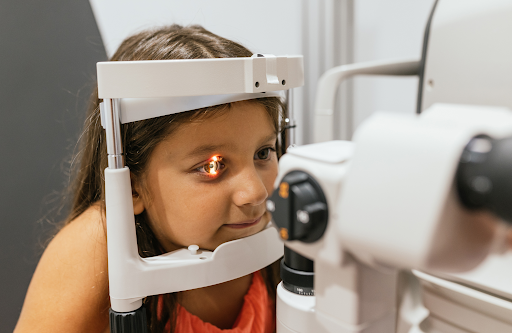
A comprehensive eye exam is the only way to definitively diagnose astigmatism. School vision screenings are helpful, but they’re not thorough enough to catch every refractive error. A full exam typically includes the following.
- Visual acuity testing, the classic “read the letters on the chart” portion
- Retinoscopy or autorefraction to measure how the eye bends light and identify any refractive error
- Keratometry to measure the curvature of the cornea
For timing, eye care experts recommend a first eye exam at 6 months, another at age 3, one more before starting school and then annually or as recommended after that.
Before the appointment, jot down anything you’ve noticed at home, like squinting, eye rubbing or headaches, along with anything your child’s teacher has mentioned. Those everyday observations give the eye doctor valuable clues.
How Is Astigmatism Treated in Children?
Astigmatism is very manageable with the right correction. Treatment depends on your child’s age, the severity of the astigmatism and your eye doctor’s recommendation. Here are the options, starting with the most common for kids.
Corrective Eyeglasses
Glasses are the first-line treatment for childhood astigmatism. The prescription lenses are shaped to compensate for the cornea’s irregular curve, directing light onto the retina the way a typical eye would.
Two encouraging things for parents to know.
- Kids adapt to glasses quickly, often within days. Many are delighted to discover how crisp the world can look.
- Because children’s eyes keep growing, the prescription may change over time. Regular exams keep it up to date.
And with today’s frame options, plenty of kids see their glasses as a favorite accessory rather than a chore.
Contact Lenses
For older children and teenagers who are ready to handle lens care responsibly, contact lenses can be a great option. Toric contact lenses are designed specifically to correct astigmatism, with a shape that aligns to the eye’s unique curve.
There’s no universal “right age” for contacts. An eye care provider can help you decide if and when they make sense for your child.
Refractive Surgery (LASIK and Others)
You may have heard of LASIK and other refractive surgeries, and it’s natural to wonder if they’re an option. For children, the answer is generally no. Because a child’s eyes are still growing and the prescription is still changing, surgery isn’t recommended during childhood. Once your child reaches adulthood and their prescription has stabilized, refractive surgery may become an option worth discussing.
Schedule Your Child’s Eye Exam
If anything in this article sounded familiar, or if your child is simply due for an exam, we’d love to help. Our caring teams make eye exams comfortable, kid-friendly and even a little fun, and we’ll walk you through every step.
Find a location near you and schedule your child’s eye exam today. Clearer days are ahead, and we can’t wait to see your child see them.